

Bio-Analytical Mass Spectrometry
MASS SPECTROMETERS
Agilent 6560 ESI-IMS-Q-TOF
High-resolution drift tube ion mobility spectrometry, electrospray ionization, Q-TOF. Mainly used to study nucleic acid G-quadruplex and riboswitch folding in solution and in the gas phase in soft conditions and for structural investigation on supramolecular complexes. The drift tube is operated in Helium or Nitrogen. The pumping system is modified to allow accurate measurement in helium.


Bruker modified timsTOF SCP
High-resolution dual-tims ion mobility spectrometry, electrospray ionization, Q-TOF.
Optimized for non-covalent complexes.

Bruker prototype timsOmni
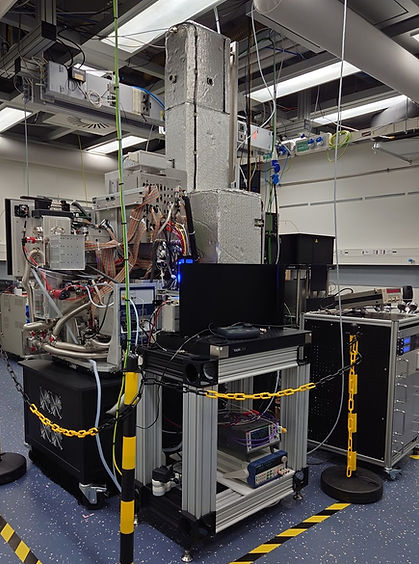
High-resolution dual-tims ion mobility spectrometry, electrospray ionization, Q-TOF coupled with omnitrap.
Optimized for non-covalent complexes and Nucleic acids TopDown sequencing.
The instrument is couple to IR laser and several UV-VIS lasers.
Modified Bruker Amazon ESI-IMS-Trap
Electrospray ionization, 3D ion trap modified and coupled to a tunable OPO laser (195 to 2000 nm) (GWU, premiscan with ultra low divergence (ULD). The pump laser is a spectra-physics Quanta-ray pro 230-30.
The instrument is used to study nucleic acid folding in solution and in the gas phase in soft conditions (ERC project).
Top-down analysis (UVPD) are performed on non-covalent complexes.
A high-resolution drift tube operated in Helium is coupled to the instrument. IMS-IMS-MS experiments can be performed.
We developped Mass-resolved electronic circular dichroism ion spectroscopy (Science, 2020, 368, 1465)
Modified Thermo Q-Ex HF


This Q-EX HF is modified to allow UV-Vis ion spectroscopy.
TRILOGY project.
Waters SYNAPT G2S


High power nanosecond tunable pulsed laser from 215 to 2000 nm. It is used to performed UVPD.
Cold Ion Spectrometer
Electropsray source. Ions are mass selected and trapped in a octopole cold trap (T°: 4K, effective ion temperature 6K).

Continuum Powerlite and Panther EXplus OPO

Ion-mobility (T-Wave) Q-TOF.

Temperature-controlled nanoelectrospray source
(J. Am. Chem. Soc. 2018, 140, 12553-12565).
Copper block
T° range: 3 - 95°C
Volume of solution: 3-10 µL
Typical experiments: from 20 to 85°C in 40 min